
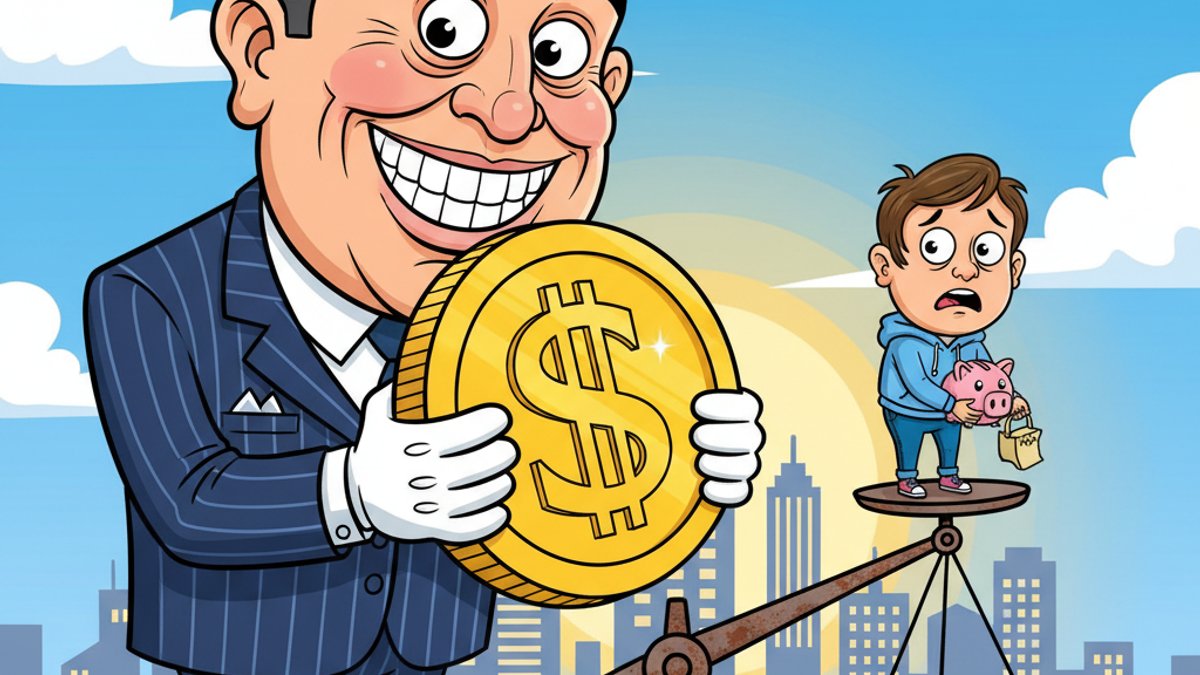
Interest is one of those words everyone uses, but few people can actually explain. Banks offer you “interest on savings” or “interest on loans,” and you just want to know — who actually gets the money and why?
Simply put: interest is the price of money. Just like you pay for bread at the store, you pay when you borrow money. And conversely — when you lend money to a bank (by saving), they pay you for using it.
How Does Interest Actually Work?
Imagine lending a friend 100 euros. You agree they’ll pay you back in a year. In the meantime, you could have spent that 100 euros on something else — you missed an opportunity. So you say: “Pay me back 105 euros.” Those 5 euros are interest — your fee for giving up your money for a year.
Banks do the same thing, just at a much larger scale:
- Saver lends money to the bank → bank pays interest to the saver
- Bank lends that money to someone else → that person pays higher interest to the bank
- The difference (spread) is the bank’s profit
Simple Interest vs. Compound Interest
This is the most important distinction you need to remember:
Simple interest — calculated only on the initial amount. If you put 1000 euros in savings at 2% simple interest per year, you get 20 euros each year. After 10 years, you have 1200 euros.
Compound interest — calculated on the initial amount AND on the interest already earned. The same 1000 euros at 2% compound interest is worth 1218 euros after 10 years. The difference seems small, but after 30 years: simple gives 1600 euros, compound gives 1811 euros. After 50 years? Simple: 2000 euros. Compound: 2691 euros.
Albert Einstein is rumored to have called compound interest “the most powerful force in the universe.” Whether he actually said it or not — he was right.
Why Do Banks Love When You Take a Loan?
Because loans are their biggest moneymaker. When you take a 10,000 euro loan at 6% interest over 5 years, you’ll pay back roughly 11,600 euros. Those 1600 euros are the bank’s profit.
And that’s fair — the bank gave you money they didn’t have (most of it comes from savers), took on the risk you might not pay back, and employs people to run the operation. Interest is their fee for that service.
How You Can Make Interest Work for You
- Start saving early. Compound interest rewards those who start young. Someone who puts away 50 euros per month starting at age 20 with 5% annual return will have ~95,000 euros by age 65. Someone starting at 35 — even saving double — will struggle to catch up.
- Watch the effective rate. Banks often advertise a “low nominal rate,” but once you add fees, processing costs, and insurance, the effective rate (APR) can be much higher.
- Avoid revolving credit. Interest on “quick” loans can reach 15-20% per year. That’s not a loan — that’s financial suicide on installment plans.
- Savings interest is taxable. In Croatia, interest income is taxed at 10%. Don’t let that stop you from saving — just factor it in.
Interest and Inflation — Why Your Savings Might Be Losing Value
If your bank gives you 1% interest on savings, and inflation is 3%, your money is losing 2% of its value each year in real terms. That’s why it’s worth exploring options like investment funds, bonds, or stocks that can potentially yield higher returns. (But with higher risk — there’s no free lunch.)
When Interest Works Against You
Credit cards are the prime example. Credit card interest in Croatia is often 12-15% per year. If you don’t pay the full amount on time, interest is calculated on the remainder from day one. The rule is simple: use your credit card like a debit card — only spend what you have.
What Now?
Interest is neither good nor bad — it’s a tool. The key is understanding when it works for you (savings, investing) and when it works against you (loans, cards). Young people who figure this out in their early twenties have decades of advantage over those who learn the hard way.
Want to learn more about personal finance? Follow Prafin — expert advice with a sense of humor. 😎